5 Ways to Monetize an AI Influencer Account
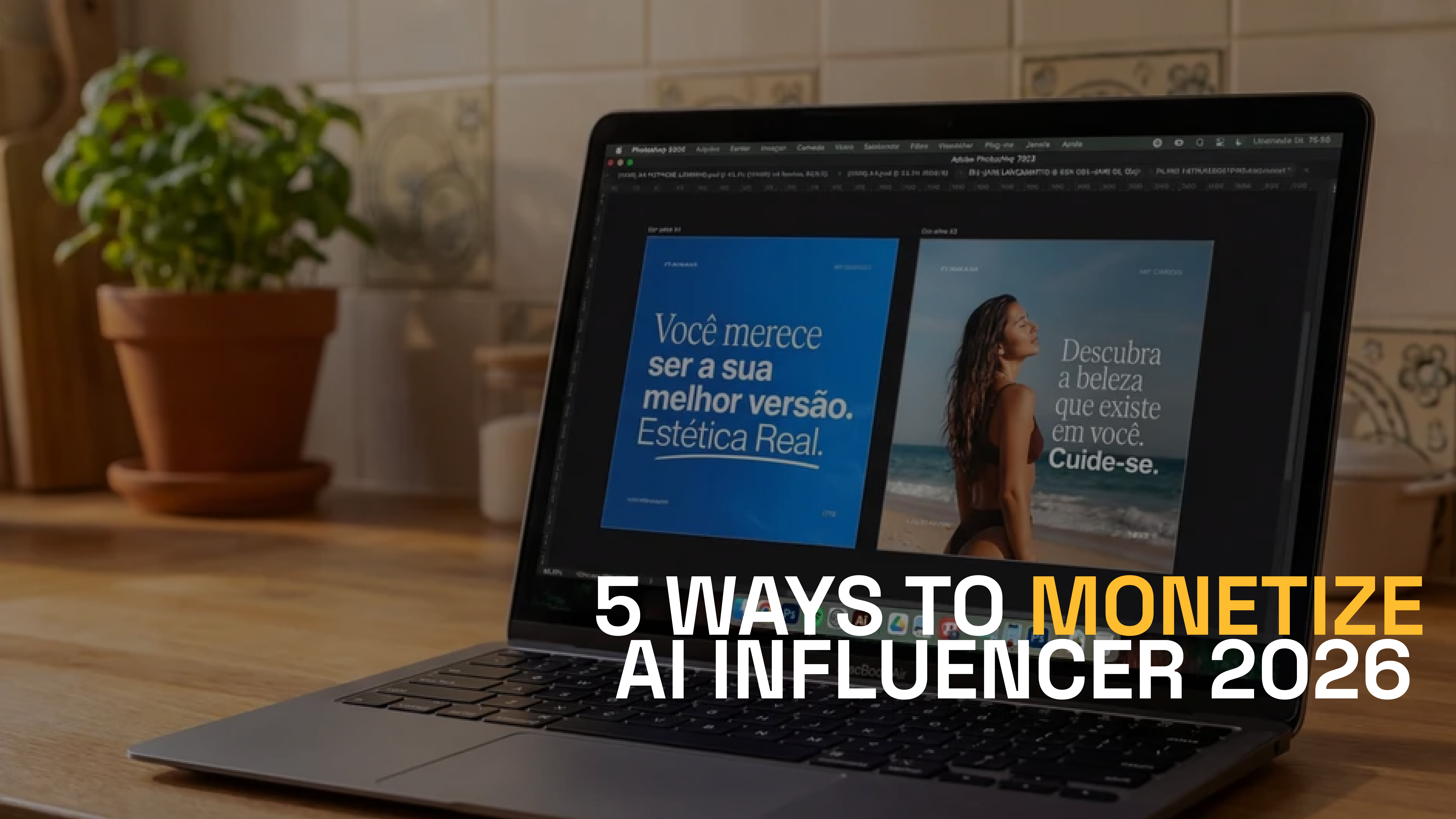
Most people who discover the AI influencer space think about it in one dimension: build an account, grow a following, land brand deals. That's the visible part of the model - the part that gets covered in articles and YouTube videos. It's real, it works, and it's worth pursuing.
But it's not the whole picture. And if brand deals are the only monetization strategy you're building toward, you're leaving a significant amount of money on the table while you wait for your following to grow large enough to attract brands.
The creators generating $5,000–$15,000/month from AI influencer accounts aren't doing it on brand deals alone. They're running multiple income streams simultaneously - some that require a large audience, some that work with a small one, and some that require no audience at all. Understanding the full stack of monetization options changes how you build, what you prioritize, and how quickly you get to meaningful income.
This article covers all five - in order of how quickly they become available to a new account, not in order of which sounds most impressive.
1. Affiliate Marketing - Income From Day One
When it becomes available: Immediately, from your first post Income potential: $200–$3,000/month depending on niche and traffic Audience size required: None - works at any following level
Affiliate marketing is the most underutilized monetization stream for new AI influencer accounts, and it's the one you should set up before you publish your first piece of content.
The model is simple: you recommend products or services relevant to your character's niche, include a trackable affiliate link, and earn a commission every time someone makes a purchase through that link. No follower count threshold. No brand approval process. No negotiation. You apply to affiliate programs, get approved, and start including links in your bio and captions.
The key to making affiliate marketing work for an AI influencer specifically is alignment between the character's lifestyle and the products being promoted. This isn't different from how it works for human influencers - it just requires a bit more intentionality because your character doesn't have "authentic" personal recommendations by default. You create that authenticity through consistent character development. A travel-focused AI influencer who always references specific travel gear, booking platforms, and luggage brands in her content can generate real affiliate income from those product mentions long before any brand reaches out for a formal partnership.
The best affiliate programs for common AI influencer niches include Amazon Associates for lifestyle and product-heavy content (3–10% commission on a massive product catalog), fashion brand affiliate programs through networks like RewardStyle and ShareASale (8–20% commission on clothing and accessories), beauty and skincare brand programs (10–20% commissions, high average order values), travel booking platforms like Booking.com and GetYourGuide (3–6% on significant transaction values), and fitness and supplement brands (15–30% commissions on repeat-purchase products).
A realistic expectation for a new account with 5,000 to 20,000 followers in a product-focused niche is $200–$800/month in affiliate income with consistent, well-placed recommendations. This scales directly with audience size and the quality of the match between character and product.
The practical setup takes about an hour. Apply to three to five relevant affiliate programs, create a Linktree or Stan.store page with organized affiliate links by category, include the link in your bio from day one, and weave natural product mentions into your content as part of the character's life rather than as obvious promotions.
The Jobescape AI Influencer course covers how to build affiliate marketing into your content strategy from the beginning - including which programs pay best by niche and how to write captions that drive click-through without feeling like ads.
2. Subscription Content - Recurring Revenue That Compounds
When it becomes available: As early as 500–1,000 followers Income potential: $500–$10,000+/month depending on subscriber count and tier pricing Audience size required: Small but engaged following
Subscription content is the income stream that most dramatically changes the financial trajectory of an AI influencer account - because it's recurring, it compounds as you grow, and it doesn't require the audience size that brand deals demand.
The model: you offer paying subscribers access to exclusive content that doesn't appear on your public feed. This might be higher-resolution versions of your best images, behind-the-scenes content showing the character's "life" in more detail, exclusive posts at a higher frequency than the public account, interactive content like Q&As answered in the character's voice, or thematic content series that only subscribers receive.
The leading platforms for this model are Patreon, Fanvue, and Ko-fi. Patreon is the most established and has the strongest discovery features. Fanvue has grown rapidly in the AI creator space specifically and has infrastructure built around virtual personas. Ko-fi is the lightest-weight option, good for simple one-tier subscription setups.
The math on subscription income is straightforward and encouraging. At a $7/month tier - a reasonable entry price for exclusive content - you need 143 paying subscribers to generate $1,000/month. You need 715 subscribers for $5,000/month. Most AI influencer accounts with a public following of 10,000 to 30,000 can realistically convert 1–3% of followers to paid subscribers with the right content proposition and consistent promotion. That means 10,000 followers can support 100–300 paying subscribers - $700–$2,100/month at the $7 tier.
Those numbers keep growing as your public following grows. And unlike brand deals, which require active outreach and negotiation, subscription revenue shows up automatically every month once the system is set up.
The content strategy for subscription tiers should be built around exclusivity and depth, not just volume. Subscribers are paying for a closer relationship with the character - more personal, more behind-the-scenes, more detailed. Think about what the character would share privately that they wouldn't post publicly. A travel AI influencer might post aspirational destination photos publicly but share the "real" side of travel - messy hotel rooms, missed flights, candid moments - exclusively for subscribers. That contrast between public persona and private depth is a compelling subscription proposition.
Building a subscription content strategy from the ground up is one of the core modules in the Jobescape AI Influencer course - including how to structure tiers, what content converts subscribers best, and how to promote your Patreon without it feeling like a constant pitch.
3. Digital Products - Build Once, Sell Forever
When it becomes available: Any stage - even before you have followers Income potential: $300–$5,000+/month (passive after creation) Audience size required: Small following or external traffic sources
Digital products are the closest thing to truly passive income in the AI influencer business. You create the product once - spend a few hours or a few days on it - list it for sale, and continue earning from it indefinitely with no additional production work.
For an AI influencer account, digital products work best when they're aligned with the character's niche and deliver genuine practical value to the audience that follows that character. Here are the categories that sell well:
Preset packs and editing filters are natural products for visually-focused AI influencer accounts. Your character's aesthetic is defined by its visual style - that style, packaged as Lightroom presets or Instagram filter packs, is something your audience wants to replicate in their own photography. AI influencer accounts in fashion, travel, and lifestyle can sell preset packs for $10–$30 with conversion rates that make the total income significant at even modest audience sizes.
Wallpaper and digital art collections are particularly well-suited to AI influencer accounts because the content you're already generating - high-quality AI images - is literally the product. Package your twenty best character images as phone wallpapers, desktop backgrounds, or printable art. Sell them on Gumroad or Etsy for $5–$15. The creation effort is zero because you've already made the images.
Niche-specific guides and ebooks work when your character is positioned around expertise or a specific lifestyle. A fitness AI influencer's training guide, a travel AI influencer's destination guide, a style AI influencer's capsule wardrobe framework - these are practical products that serve the audience while reinforcing the character's positioning. Price these at $15–$49 depending on depth and production quality.
Prompt packs and AI tool guides are a meta-product that works particularly well in the AI creator community. If your character is positioned in a tech-adjacent niche, or if your audience includes other creators who want to learn from how you build the account, a guide on AI image generation prompts, character consistency techniques, or content production workflows can sell consistently to a targeted audience.
Templates - content calendar templates, brand pitch templates, affiliate tracking spreadsheets, Notion dashboards - serve the creator community audience that naturally gravitates toward AI influencer accounts. These can be priced at $10–$25 and require minimal production time.
The distribution model for most digital products is Gumroad, which takes a small percentage of sales and handles delivery automatically. You list the product, set the price, share the link in your bio and periodically in your content, and the sales happen without your involvement.
The Jobescape AI Influencer course includes a module on digital product creation and positioning - covering which product types perform best by niche and how to integrate product promotion naturally into your content calendar.
4. Brand Partnerships - The Income Stream Worth Waiting For
When it becomes available: Typically 10,000–50,000 followers for first deals Income potential: $500–$50,000+/month depending on following size and niche Audience size required: Moderate - 10K+ for first paid deals
Brand deals are the monetization stream most associated with influencer marketing - and for good reason. They're the highest-paying individual transactions available to a creator at scale, and for AI influencer accounts specifically, the terms often favor the creator more than they do for human influencers.
Here's the basic structure. A brand pays you to feature their product in one or more posts on your account. The content shows your character using, wearing, or engaging with the product in a way that aligns with her aesthetic and niche. The brand gets access to your audience in a context that feels native to the feed rather than like a display ad.
For AI influencers, brand partnerships have several structural advantages over the same arrangement for human creators. Brands have complete creative control - they can specify exactly how the product should appear, what setting the character should be in, and what the caption should say. There's no negotiation over "authenticity" or the creator's personal voice. The content can be produced faster and revised more easily than with a human creator. And there's no risk of the creator going off-brand or causing reputational damage.
These advantages mean that brands who understand the AI influencer model are often willing to pay comparable or premium rates for it - particularly for visually-driven niches where the content quality of AI generation is highest.
Reaching out to brands proactively is the fastest path to first deals. Don't wait for brands to find you. Research which brands are spending on influencer marketing in your niche, identify the marketing or partnerships contact, and send a short, confident pitch with your account statistics, your engagement rate, two or three examples of your best content, and a suggested collaboration idea that fits their brand. Keep the initial message to five or six sentences.
A media kit - a one-page document showing your follower count, engagement rate, audience demographics, niche, and past collaborations - is essential for professional brand outreach. You don't need past brand deals to have a media kit. You can present your organic content statistics and your account positioning as the foundation.
Rates to target as you grow: $100–$500 per post at 10,000–30,000 followers (strong engagement in a commercial niche), $500–$2,000 per post at 30,000–100,000 followers, $2,000–$10,000 per post at 100,000–500,000 followers. Long-term ambassador arrangements - where a brand pays for exclusivity and multiple content pieces over a period of months - command significantly higher total fees and are worth pursuing once you have two or three successful single-post collaborations to reference.
Pitching brands confidently and professionally is one of the most valuable skills you'll build in the Jobescape AI Influencer course - including how to write outreach messages that get responses, how to structure your media kit, and how to negotiate rates without leaving money on the table.
5. Selling AI Influencer Creation as a Service - The Highest Ceiling
When it becomes available: As soon as you have a functioning account as proof of concept Income potential: $2,000–$15,000/month Audience size required: None - this is a B2B service
This is the monetization stream that most AI influencer creators discover late — and then wish they'd started earlier. It is the highest-income-potential stream on this list, it doesn't require a large audience, and it can generate significant revenue from the first month.
The model: you take the skills you've developed building your own AI influencer account - character design, visual identity generation, content production, platform management - and sell them as a service to businesses that want a virtual persona of their own.
The market for this service is enormous and largely untapped. Every brand that currently spends on human influencer partnerships is a potential client. Every company building a direct-to-consumer brand that wants a recognizable visual identity without tying it to a specific person is a potential client. Every agency serving those brands is a potential client.
What businesses are buying when they hire you falls into a few distinct service packages. Brand persona creation is the foundational service: you build a complete AI influencer character for the brand - visual identity, character backstory, content style guide, initial image library - and hand it over. Project fees for this range from $2,000 to $8,000 depending on complexity and your track record. Content production retainers involve ongoing monthly work producing content for the brand's AI persona - a set number of posts per month, captions included, delivered ready to schedule. Monthly fees for this range from $1,000 to $3,000. Full account management means you handle everything - creation, content, posting, engagement, and performance reporting - for a brand that wants a turnkey virtual influencer operation. This is the highest-value service tier, priced at $2,500–$6,000/month.
The sales process for this service is different from the audience-building work of your own account. You're selling to marketing managers, brand directors, and agency creative leads - business decision-makers who think in terms of ROI and deliverables. Your own AI influencer account is your portfolio and your proof of concept. A 20-minute walkthrough showing what you built, how it works, and what results it has achieved is the most effective sales tool you have.
Finding clients starts with direct outreach to brands in your niche that are already spending on influencer marketing, LinkedIn outreach to marketing decision-makers, and pitching to digital marketing agencies who could offer AI influencer services to their existing client base. The agency route in particular can scale quickly - one agency relationship can bring multiple client projects without additional sales effort on your part.
This service model means your AI influencer skills have two parallel income tracks: your own account growing and generating audience-based income over time, and a client service business generating project income immediately. Most successful AI influencer creators end up running both simultaneously - the service income funds the time invested in building their own account, and the account provides ongoing social proof for the service.
The Jobescape AI Influencer course covers how to package and sell AI influencer creation as a service - including how to structure your offer, price your packages, find your first client, and deliver professionally. This module alone covers the cost of the course many times over for creators who execute on it.
Building the Full Stack
The real income potential of an AI influencer business emerges when all five streams are running simultaneously.
In the early months, affiliate marketing and a basic subscription tier generate the first income while the audience is building. Digital products can be launched immediately and promoted organically as the account grows. Brand outreach starts when the account reaches the threshold where engagement data makes a compelling pitch. And service clients can be approached from month one, using the account in progress as the portfolio.
A creator twelve months into building a mid-tier AI influencer account in a strong commercial niche, running all five streams, might look something like this: $400/month in affiliate commissions from consistent product mentions, $800/month from 115 Patreon subscribers at a $7 tier, $600/month in digital product sales from a preset pack and a niche guide, $2,000/month from two brand partnership posts, and $3,000/month from one ongoing service client whose brand persona they manage. That's $6,800/month from a single AI influencer operation - built over twelve months of consistent work.
None of those numbers are exceptional for an individual stream. Combined, they represent a serious income. That's the point.
Ready to Build This Business?
Every monetization stream described in this article is teachable and executable. But execution is easier, faster, and more profitable when you're following a structured process rather than figuring it out through trial and error over eighteen months.
The Jobescape AI Influencer course walks you through building all five income streams - from setting up your first affiliate links on day one to pitching your first brand deal to packaging your skills as a client service. You'll learn which platforms to use for each stream, how to integrate monetization naturally into your content without alienating your audience, and how to sequence your efforts so you're generating income at every stage of account growth, not just after you've built a large following.
No design background, no existing following, no prior business experience required. Just the process, the tools, and the community to build it right.
→ Join the AI Influencer course and start building your multi-stream AI creator business today.
Frequently Asked Questions
Q: Which of these five income streams should I start with first?
A: Affiliate marketing and digital products first, because both work at zero followers and require minimal setup. Launch your Patreon or subscription page once you have your first 500 to 1,000 engaged followers. Begin brand outreach when you reach 10,000 followers with solid engagement data. Start pitching AI influencer creation as a service as soon as your own account is developed enough to serve as a portfolio - which can be as early as one to two months in.
Q: How much can I realistically earn in the first three months?
A: In the first three months, realistic expectations are $200–$800/month from affiliate marketing and digital products, plus potentially $500–$1,500 from an early service client if you actively pursue that track. Brand deals and meaningful subscription income typically come in months three to six. Total first-three-month income for someone actively pursuing all streams: $500–$2,500/month.
Q: Do I need to disclose affiliate relationships and brand partnerships?
A: Yes, in virtually all markets. FTC guidelines in the US, ASA rules in the UK, and equivalent regulations in the EU and Australia all require disclosure of paid partnerships and affiliate relationships. For AI influencer accounts, this means clearly marking sponsored posts and using standardized disclosure language for affiliate links. The reputational and legal risk of not disclosing outweighs any perceived benefit of keeping it subtle.
Q: Can I run multiple AI influencer accounts across different niches simultaneously?
A: Yes - and this is one of the structural advantages of the AI influencer model over human creator accounts. Multiple accounts in different niches can be managed by a single creator with a well-built content production system. Experienced AI influencer creators often run two to four accounts simultaneously, each generating independent income from the five streams covered in this article.
Q: Is it worth building the service business track even if I ultimately want to focus on my own account?
A: Almost always yes. Service clients generate immediate income that funds the time you invest in building your own account. The skills you develop serving clients - character development, visual consistency, content strategy - directly improve your own account. And the case studies from client work accelerate your credibility when pitching future brand deals for your own persona. The two tracks reinforce each other rather than competing for your attention